
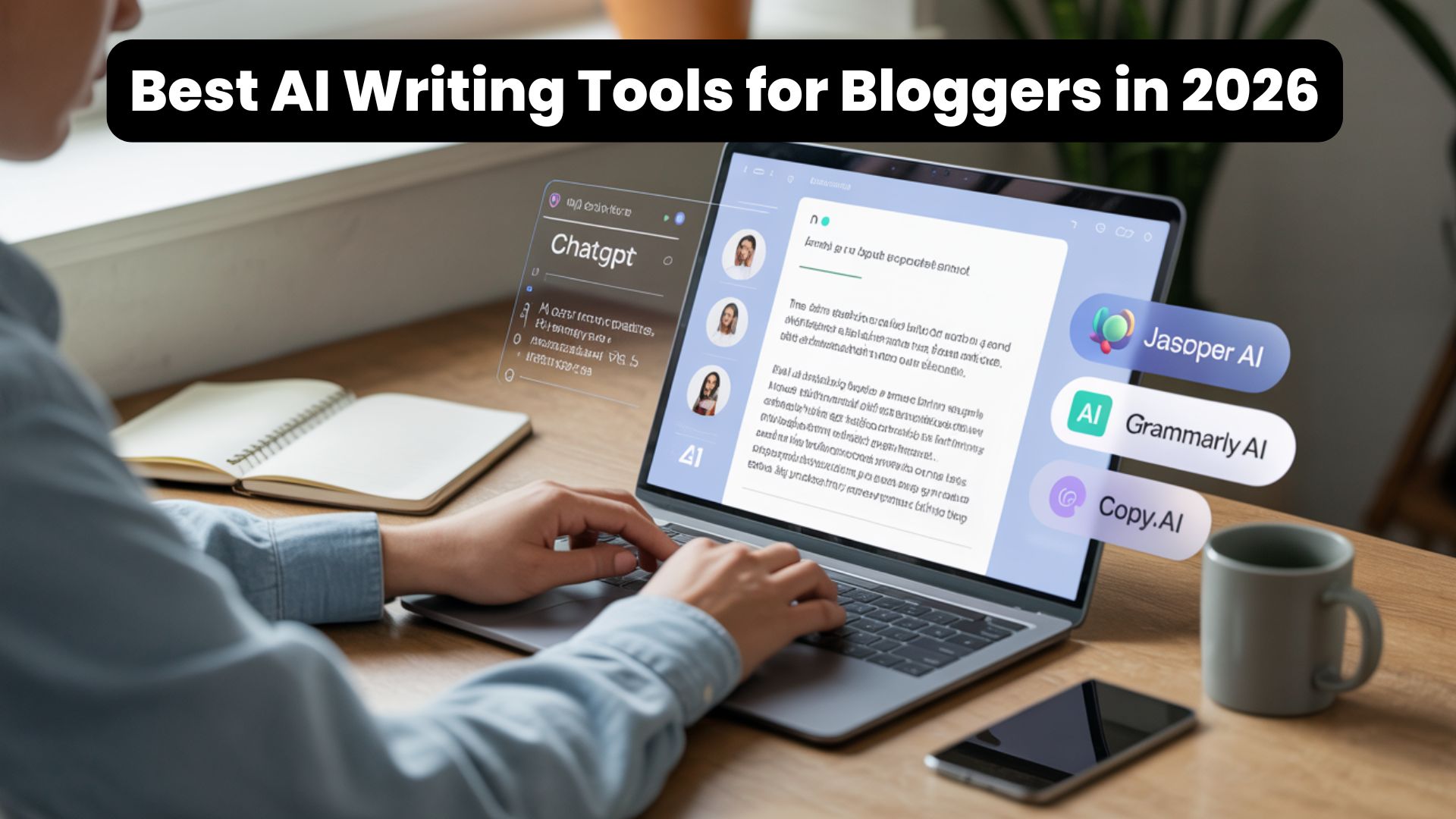
In this article, we review the best AI writing tools for bloggers in 2026, focusing on real use cases and practical workflows. Publishing speed matters. Search intent matters. Consistency matters most. AI writing tools now sit at the center of modern blogging workflows, not as replacements for human writers, but as productivity engines.
Bloggers who use AI correctly publish faster, research better, and edit smarter. Bloggers who ignore AI struggle to keep up. Curate Daily guide, explains which AI writing tools actually help bloggers in 2026, how they fit into real workflows, and how to choose the right one without wasting money.
Why Bloggers Need AI Writing Tools in 2026
Blogging today demands volume and quality together. Search engines reward depth. Audiences expect clarity. Social platforms require repurposed content.
AI writing tools help bloggers in three critical ways.
First, they reduce starting friction. Blank pages slow writers. AI outlines remove hesitation. Momentum follows structure.
Second, they improve efficiency. Drafts appear faster. Edits take less time. Publishing becomes predictable.
Third, they support SEO alignment. Modern AI tools analyze structure, keywords, and readability while you write.
The most successful bloggers do not outsource thinking to AI. They outsource repetition. Strategy stays human. Execution becomes assisted.
What Makes an AI Writing Tool Good for Bloggers
Not every AI writing tool fits blogging needs. Many tools target marketers, not long-form creators. Bloggers should evaluate tools using practical criteria.
Context handling matters most. Blog posts require continuity. Paragraphs depend on earlier ideas.
SEO awareness matters next. Tools must understand headings, intent, and keyword placement.
Editing support matters too. Blogs improve through rewriting, not first drafts.
Workflow integration matters finally. Tools should work with WordPress, Google Docs, or Notion.
With these criteria in mind, let’s examine the best AI writing tools for bloggers in 2026.
Best AI Writing Tools for Bloggers in 2026
ChatGPT: AI Tool for Blog Ideation and Drafting
ChatGPT remains the most flexible AI writing assistant for bloggers. It excels at idea generation, outlines, and first drafts. Bloggers use it to explore angles, simplify explanations, and restructure content.
Its strength lies in context awareness. Long articles stay coherent. The tone stays adjustable. Instructions remain remembered within sessions.
Bloggers typically use ChatGPT to draft sections, not entire articles. Human editing follows. The result feels natural, not automated.
Best for bloggers who value control, depth, and versatility.
Jasper AI: AI Tool for Structured Blog Writing
Jasper AI focuses on repeatable content creation. Bloggers use it when consistency matters across posts. Templates guide structure. Brand voice stays stable.
Jasper performs well for blog introductions, summaries, and call-to-action sections. It fits bloggers running niche sites or content teams.
The downside appears with exploratory writing. Creative depth feels limited without customization.
Best for bloggers managing scale or monetized content funnels.
Writesonic: AI Tool for Speed and Simplicity
Writesonic appeals to bloggers who prioritize speed. Drafts appear quickly. Short-form blog sections work well. SEO suggestions integrate directly.
Quality depends heavily on prompts. Bloggers who refine inputs get strong outputs. Those who rush see generic text.
Writesonic works best for supporting content, not flagship articles.
Best for bloggers publishing frequently across multiple topics.
Frase: AI Tool for SEO-Driven Blogging
Frase combines research and writing. Bloggers use it to analyze search results before drafting. Headings reflect competitor patterns. Content gaps become visible.
Frase excels during planning stages. Writers understand what Google expects before writing begins.
Drafting quality remains solid, though not creative. Frase acts as a strategic assistant more than a stylistic one.
Best for bloggers focused on rankings and topical authority.
Surfer SEO: AI Tool for Content Optimization
Surfer SEO supports bloggers after drafts exist. It analyzes keyword density, structure, and semantic coverage in real time.
Bloggers pair Surfer with other AI tools. Draft first. Optimize second.
Surfer improves existing content more than it creates new content. Rankings often improve after optimization.
Best for bloggers who already understand writing but want SEO precision.
Grammarly AI: AI Tool for Editing and Clarity
Grammarly AI handles the final polish. Bloggers rely on it to improve sentence flow, tone, and clarity.
It catches issues humans miss. It shortens long sentences. It removes ambiguity.
Grammarly does not generate ideas. It strengthens execution.
Best for bloggers who value professional readability.
Notion AI: AI Tool for Content Planning
Notion AI supports organization. Bloggers use it to manage editorial calendars, research notes, and article frameworks.
It summarizes research. It rewrites notes. It clarifies messy drafts.
Notion AI improves thinking space, not publishing output.
Best for bloggers managing multiple projects or long-term content strategies.
Rytr: AI Tool for Budget Bloggers
Rytr offers basic AI writing at low cost. Bloggers use it for outlines, short sections, and idea expansion.
Long-form depth feels limited. Editing becomes necessary.
Rytr suits beginners testing AI writing without heavy investment.
Best for new bloggers or side projects.
| Tool | Best For | Strength | Limitation |
|---|---|---|---|
| ChatGPT | Long-form drafting | Context and flexibility | Requires manual SEO |
| Jasper AI | Scalable blogging | Structured templates | Higher cost |
| Writesonic | Fast content | Speed | Prompt sensitivity |
| Frase | SEO planning | SERP analysis | Less creative |
| Surfer SEO | Optimization | Ranking alignment | Not a writer |
| Grammarly AI | Editing | Clarity | No ideation |
| Notion AI | Planning | Organization | Not publishing |
| Rytr | Budget use | Accessibility | Shallow depth |
Curate Daily Insight: How Bloggers Actually Use AI Writing Tools in 2026
At Curate Daily, we analyze AI usage patterns across independent bloggers, niche site owners, and editorial teams. One trend stands out in 2026: bloggers do not use AI writing tools to replace writing. They use them to protect consistency and momentum.
Most bloggers start with AI during the planning stage. Tools like ChatGPT or Frase help map outlines, clarify search intent, and structure articles before writing begins. This early assistance reduces decision fatigue and prevents abandoned drafts, which remains one of the biggest challenges for solo bloggers.
During drafting, bloggers rarely rely on a single tool. Instead, they mix tools based on task type. Long-form sections often begin with conversational AI, while SEO alignment and structure are refined using optimization tools. This layered approach allows bloggers to maintain voice while still meeting search engine expectations.
Editing shows the strongest AI adoption. Bloggers use AI to tighten sentences, simplify explanations, and maintain consistent tone across posts. This step matters most for trust. Content that reads clearly performs better, earns longer time-on-page, and attracts repeat readers.
Another key insight is restraint. Bloggers who grow sustainably limit their AI stack. They choose three to five tools that integrate well, rather than experimenting endlessly. This focus creates repeatable workflows and predictable publishing schedules.
The most successful bloggers treat AI as an assistant that accelerates execution, not a shortcut for expertise. Human experience still shapes opinions, examples, and judgment. AI handles structure, speed, and refinement.
This balanced approach explains why AI-assisted blogs in 2026 publish more consistently, rank more reliably, and retain stronger audience trust.
A Practical Blogging Workflow Using AI
Successful bloggers use AI in stages.
- They begin with research. Frase or ChatGPT identifies angles.
- They move to structure. ChatGPT builds outlines. Notion stores plans.
- They draft sections. ChatGPT or Jasper assists.
- They optimize content. Surfer SEO adjusts the structure.
- They polish writing. Grammarly improves clarity.
Each tool performs one role. No single tool does everything well.
This modular approach prevents dependency and improves quality.
Common Mistakes Bloggers Make With AI Writing Tools
Many bloggers publish raw AI output. Readers notice. Trust drops.
Some bloggers over-optimize. Content feels robotic.
Others chase too many tools. Productivity falls.
The best bloggers treat AI as support, not replacement. Editing remains essential. The voice stays human.
The Future of AI Writing for Bloggers
AI writing tools will become more integrated. Planning, drafting, and optimization will merge into unified workflows.
Human bloggers will still lead. Strategy, insight, and experience remain irreplaceable.
AI handles speed. Humans handle meaning.
Bloggers who learn this balance will dominate search and audience trust in 2026.
Final Thoughts
AI writing tools no longer offer advantages by themselves. Advantage comes from how bloggers use them.
Choose tools that fit your workflow. Avoid tools that promise shortcuts. Focus on clarity, usefulness, and consistency.
In 2026, successful bloggers will not write less. They write smarter.
And AI helps them do exactly that.
Frequently Asked Questions (FAQ)
What are AI writing tools, and how do bloggers use them in 2026?
Can AI writing tools replace human bloggers?
Are AI-written blog posts safe for SEO?
Which AI writing tool is best for beginner bloggers?
Do professional bloggers use multiple AI writing tools?
Is it ethical to use AI writing tools for blogging?
How do AI writing tools help with writer's block?
Are free AI writing tools enough for blogging?
Will Google penalize blogs that use AI writing tools?
How should bloggers choose the right AI writing tools?
Need more guidance on AI writing tools? Visit our blogging resources section